ELEVEN to ONE
When was the last time you changed your mind because of a conversation?
Not because you were defeated. Not because you ran out of arguments. But because someone said something true — something you hadn't considered — and you felt the ground shift a little under your position. You sat with it. And then you thought: maybe I was wrong.
That's a rare thing now. We've built an entire media ecosystem around the premise that changing your mind is weakness. That the goal of any conversation is to win it. That listening is just waiting to talk.
Eleven to One is about what happens when twelve ordinary Americans are put in a room together — no phones, no audience, no escape — and asked to make a real decision. And what happens to the man who put them there, watching through a one-way mirror, when the decision stops being the one he paid for.
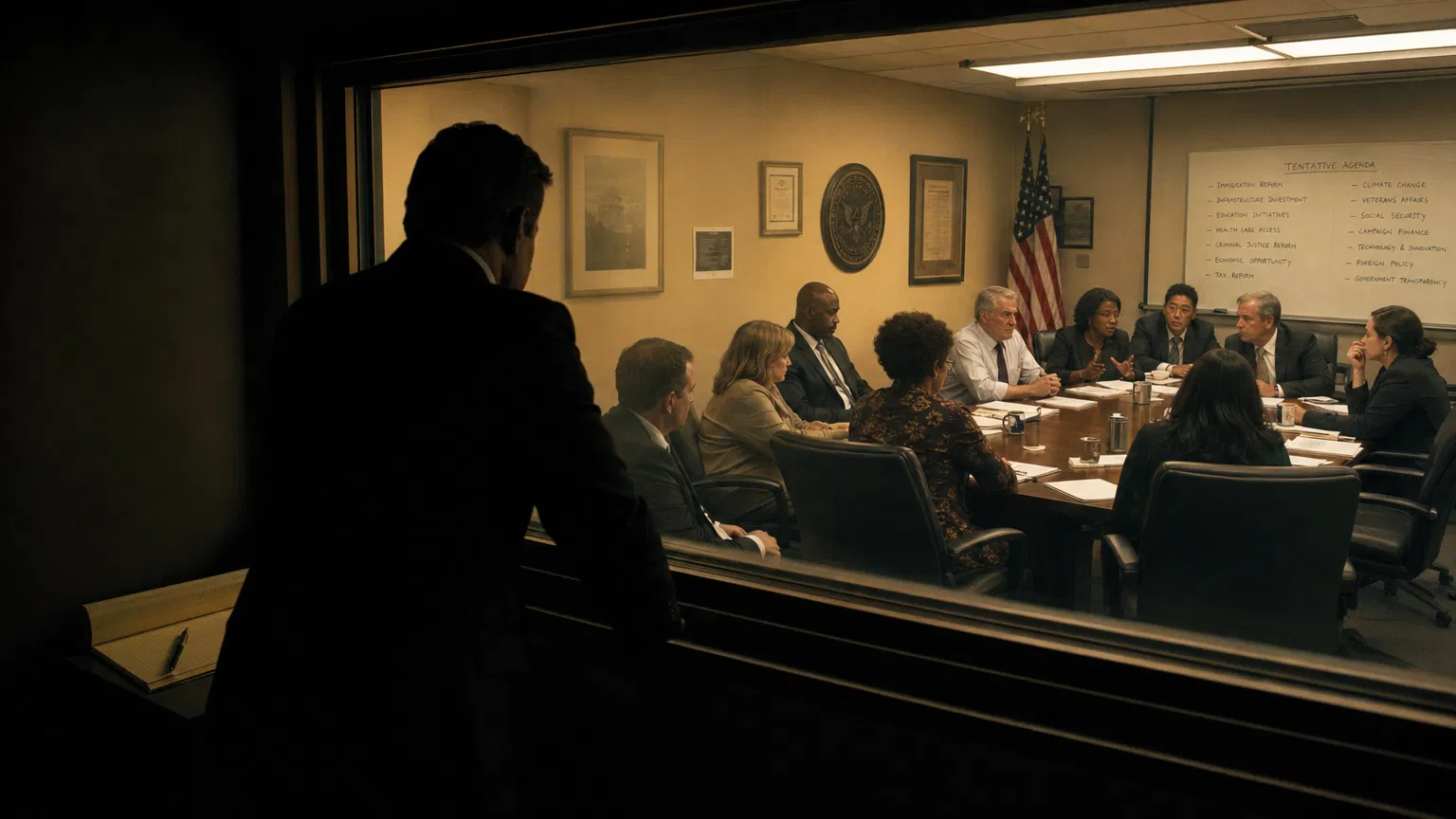
There is a conference room in a mid-sized American city. Twelve chairs around a long table. Twelve folders, each containing a document that is mostly redacted. A whiteboard at the far end. An American flag in the corner. Fluorescent light overhead.
On the far wall: a mirror.
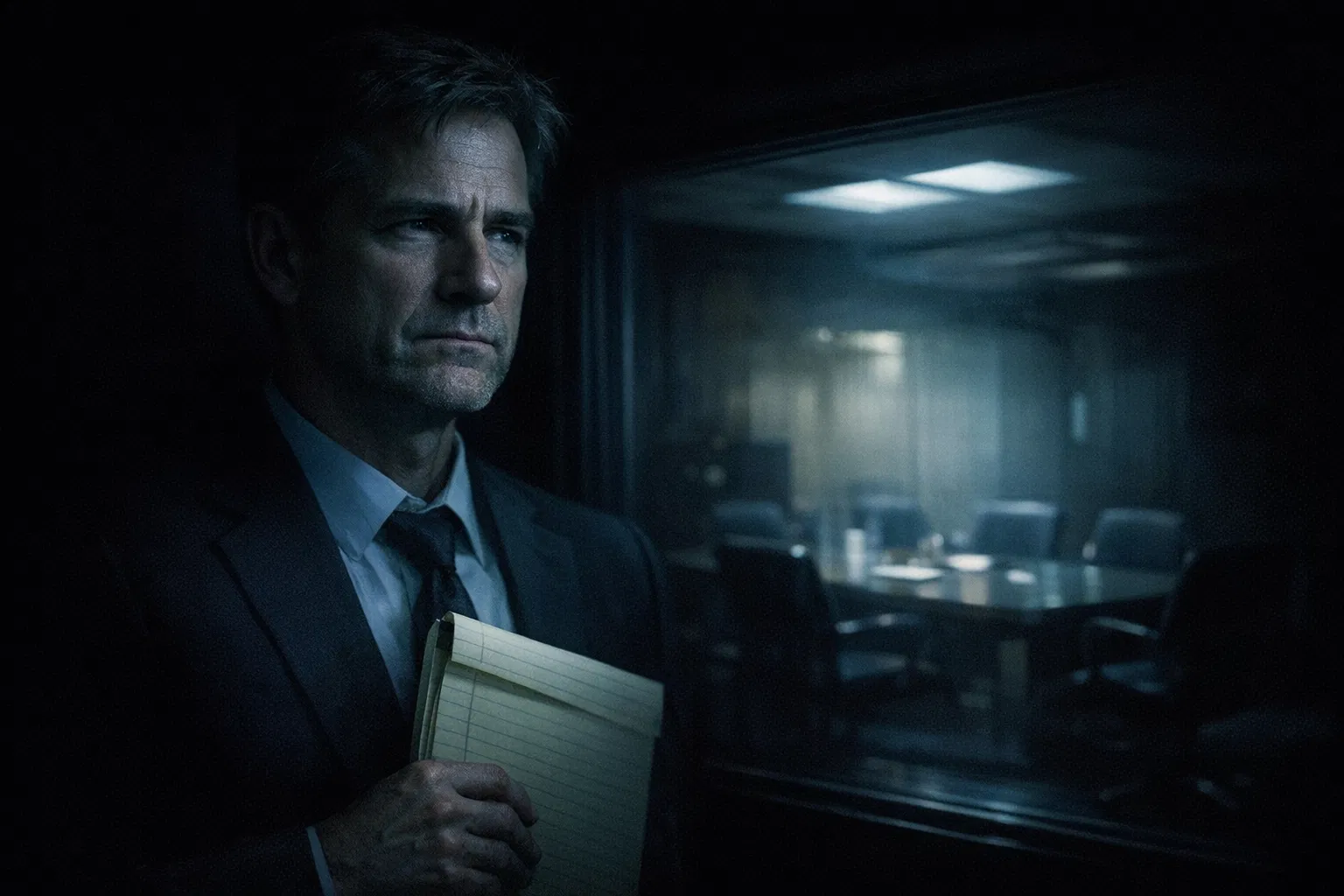
Behind the mirror: a man named Marsh. He has a legal pad, a cold coffee, and a model — a detailed behavioral profile of every person in that room, built over three months by a firm that specializes in this kind of work. He has done this before. He knows how it ends.
The twelve people in the room have been told they are a Citizens' Advisory Panel, convened to review a regional infrastructure proposal and issue a non-binding recommendation. They have been told the process will take approximately ninety minutes. They have been told their participation is voluntary and their deliberations are confidential.
They have not been told about the mirror.
They have not been told about Marsh.
They have not been told who is paying for the room.
The vote, according to Marsh's model, will be eleven to one in favor. The one dissenter — a retired schoolteacher named Ray — will raise a procedural objection, hold out for twenty minutes, and then fold. Marsh has seen this pattern forty-seven times. He has never been wrong.
At 9:04 AM, Ray opens his folder, reads the first page, and says: "I'd like to talk about it first."
Marsh writes the time on his legal pad. He is not worried. He starts a new page.
The nine people in the room are not types. They are not symbols. They are specific — which is the only thing that makes drama work.
Sixty-three years old. Taught high school civics for thirty-one years in a district that no longer teaches civics. He came to this room because he was asked, and because he believes that when you're asked to participate in something, you should. He has no idea what he's about to do.
Seventy-one. Worked the line at a manufacturing plant for twenty-two years before it closed. He has been in enough rooms like this one to know that the folder is not the point. He is watching Ray.
Forty-four. Runs a small catering business. She lives four blocks from the property described in the document — a fact she discovers on page three, which she is the first person to reach because she reads quickly and she doesn't stop.
Fifty-eight. She came in with a position. She is not wrong to have one. She will spend the next ninety minutes discovering that the position she came in with was built on information she didn't know was incomplete.
Thirty-seven. He has been to the community meetings. He knows what Harwick Capital Group is. He has been waiting for someone else to say it first.
Sixty-six. She reads footnotes. This will matter.
Twenty-nine. He grew up on Route 9. He knows what the old mill property is, what it was, and what it meant to the people who worked there. He has not planned to say any of this. He will say all of it.
Forty-one. She arrived early. She set up her things carefully. At minute fourteen, she excuses herself to use the restroom. She does not take her bag. She leaves her phone face-down on the table. She comes back seven minutes later and does not explain where she went. No one asks.
Forty-nine. He is not in the room. He has never been in a room like this one — not as a participant, not as a citizen, not as a person with something at stake. He has always been on the other side of the glass. This is the only fact about him that matters.
The first vote is eleven to one. Ray is the one.
He doesn't argue. He doesn't object. He just says he'd like to understand what they're actually being asked to decide before they decide it. Walter seconds him. The room, which had been ready to adjourn, settles back into its chairs.
What follows is ninety minutes of something that almost never happens anymore: twelve people, none of whom agree on everything, working through a real question together. They fight. They misunderstand each other. They make assumptions that turn out to be wrong. They find, in the middle of an argument about property values, that they are actually having an argument about what a community owes the people who built it.
Rosa finds her neighborhood in the document. The room goes quiet.
June finds Harwick Capital Group in the footnotes. The room goes quieter.
Walter says: “I’ve been in rooms like this my whole life. They always tell you it’s about something else.”
Tommy talks about his father. He hadn't planned to. He doesn't stop.
Behind the mirror, Marsh fills three pages of his legal pad and then stops writing. He is watching something he doesn't have a category for. His model predicted the arguments. It predicted the hesitations. It did not predict the moment when twelve strangers stop performing their positions and start actually talking to each other.
At minute seventy-three, the vote moves.
At minute eighty-one, it moves again.
At minute eighty-eight, Marsh's phone buzzes. He looks at it. He puts it face-down on the desk.
The final vote is not what he was paid to produce.
He sits in the dark room for a long time after everyone else has left. Then he picks up his legal pad, walks out of the building, and does not make the call.
We are living through a crisis of deliberation. Not a shortage of opinions — an excess of them, moving too fast, in too many directions, with no mechanism for resolution. The loudest voices have convinced us that the only two options are winning and losing. That listening is surrender. That the people on the other side of any argument are not just wrong but irredeemable.
Eleven to One is a story about what happens when that assumption is tested in a room with no exit.
It is not a political drama in the conventional sense. It takes no sides. It names no party. The question being voted on is deliberately kept vague — because the specific policy is not the point. The point is the process. The point is what twelve people discover about each other, and about themselves, when they are asked to make a real decision together and given the time to do it.
The form is as old as 12 Angry Men — one room, real time, no escape. Sidney Lumet proved in 1957 that this container, properly filled, is one of the most powerful structures in dramatic storytelling. The pressure builds because there is nowhere for it to go. The characters reveal themselves because there is no audience to perform for. The story works because the stakes are human, not cinematic.
What makes Eleven to One different is the second room. Marsh is not a villain. He is a professional — a man who has spent his career managing outcomes from the outside, who has never sat in a room like the one he built, who watches democracy work despite him and has to decide what to do with that. His arc is the story's moral center: not a conversion, not a punishment, but a reckoning. The question the film leaves him with — and the audience with — is the same one Ray asked at the beginning.
"I'd like to talk about it first."